

Evidence-Based Policymaking in a Fragmented World
IEP Bocconi Director Paloma Lopez-Garcia’s welcome remarks at the opening of the Second Junior Workshop in Geoeconomics, organized with the Kiel Institute and the BAFFI Centre
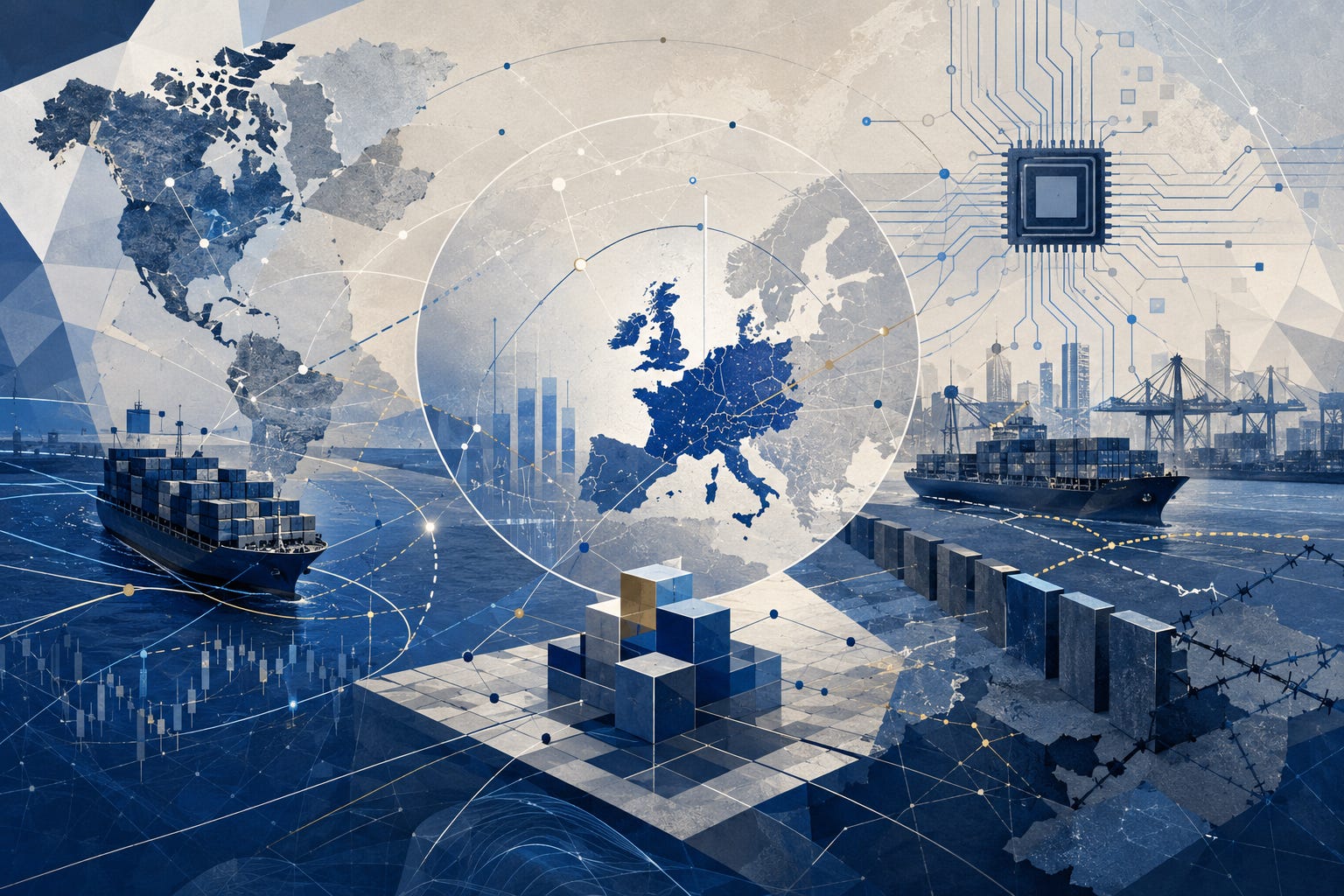
We often hear that we live in an era of uncertainty, which is true. But uncertainty is an argument for relying on evidence more, and not less. In other words, when the world becomes more complex, the value of rigorous analysis increases—for welfare and for good policymaking
Paloma Lopez-Garcia
IEP@BU does not express opinions of its own. The opinions expressed in this publication are those of the authors. Any errors or omissions are the responsibilit
On June 10, Bocconi University hosted the Second Junior Workshop in Geoeconomics, organized by IEP Bocconi in collaboration with the Kiel Institute and the BAFFI Centre, Research Unit PERICLES.
The workshop brought together young researchers, senior scholars and discussants for a full day of presentations and debate on the relationship between economics and geopolitics.
The programme focused on three main areas: geopolitics and finance, including conflict, sanctions and cross-border lending; geopolitics and trade, including trade agreements, reshoring and economic coercion; and international cooperation in a fragmented world, with sessions on industrial policy, deterrence, global public goods and financial cooperation.
The event also included a guest speech by Nicola Limodio and Lucas A. Mariani on sanctions, financing constraints and the organization of conflict; a keynote speech by Massimo Morelli, Gianmarco Ottaviano and Tommaso Sonno on protectionism and the GAFAM surplus; and the announcement of the Best Paper Award.
The workshop marked the first public event of Paloma Lopez-Garcia as Director of IEP Bocconi. In her welcome remarks, López-García framed geoeconomics as a field in which rigorous research is increasingly necessary for public policy.
Good morning everyone,
It is a great pleasure to welcome you to Bocconi University and to the Second Junior Workshop in Geoeconomics.
I would like to begin by thanking the organizers for putting together such a great programme, as well as the discussants, the keynote speakers, and especially the young researchers who will present their work today.
Let me tell you that this is my first event as the new Director of the Institute for European Policymaking at Bocconi University. And that makes me particularly happy.
There are three reasons for this.
First, this workshop perfectly embodies what I believe the Institute should stand for: rigorous academic research addressing questions that matter for public policy; dialogue between scholars at different stages of their careers; openness to different perspectives; and, above all, a commitment to evidence and analytical rigour.
This is always important, but today it is crucial because public debates are often dominated by strong opinions and simple narratives. We need informed discussions and evidence-based policymaking. In that context, your work, our work, is fundamental.
The second reason I am really pleased to be here today with you is that there could hardly be a more appropriate topic for such an evidence-based discussion than geoeconomics.
For several decades, economists could often analyse trade, finance, technological change or industrial development under the assumption that economic efficiency was the dominant objective and that international rules simply provided the framework.
Today, the world looks very different.
Wars and geopolitical tensions affect financial flows and investment decisions. Trade relationships are increasingly shaped by strategic considerations. Governments use sanctions, export controls and industrial subsidies as instruments of policy. Concerns about resilience, security and technological leadership increasingly influence decisions that were once guided primarily by efficiency.
In short, economics and geopolitics can no longer be studied separately and have become central to policymaking. And there is certainly no shortage of policy-relevant questions that should be answered based on research. Let me give you some examples.
How should Europe respond to a world in which trade is increasingly conditioned by security concerns?
How can we strengthen resilience without sacrificing the benefits of openness?
What forms of economic dependence create genuine vulnerabilities?
How should policymakers think about sanctions? Under what conditions are they effective? What are their economic costs and unintended consequences?
What is the right balance between industrial policy and competition?
How can Europe strengthen its technological capabilities while preserving an open and innovative economy?
How can international cooperation survive in a world that appears increasingly fragmented?
These are all questions about security and strategy. But they are also questions about productivity, innovation and prosperity, because the choices we make in response to geopolitical fragmentation will influence where investment takes place, how technologies diffuse across borders, how firms organize their supply chains, and ultimately how fast our economies grow.
Hence, the challenge is not simply to become more resilient. It is to become more resilient while remaining innovative, competitive and prosperous.
That is not as easy as it might sound because these objectives are not always mutually reinforcing. Building resilience may increase costs. Strategic autonomy may create tensions with openness. Industrial policy may raise important questions about efficiency and competition.
Understanding where complementarities exist and where difficult trade-offs emerge is one of the central tasks of evidence-based policymaking. The programme we have today will certainly help to shed light on these trade-offs.
The first session examines the relationship between geopolitics and finance, including conflict, sanctions and financial interdependence.
The second focuses on trade, looking at issues such as trade agreements, reshoring and economic coercion.
The third turns to international cooperation, industrial policy and the provision of global public goods in a fragmented world.
It is a great programme, and I will follow the discussions with great interest.
Let me now turn to the third reason I am particularly happy to be here with you today: the people presenting are junior researchers.
Why is this important?
Many of the challenges we face today are relatively new. The analytical frameworks that guided policymaking twenty years ago are often no longer sufficient or appropriate to understand the world we are living in today.
Progress will therefore depend not only on established experts, but also on a new generation of scholars willing to challenge conventional wisdom, develop new methods and ask new questions.
The future of evidence-based policymaking depends on this intellectual renewal. A bit like productivity growth depends on creative destruction.
Let me also take this opportunity to share a thought with the young researchers presenting today.
As academics, we are all trained to think about our contribution to the literature. We ask ourselves: what is new in my paper? How does it relate to previous work? What gap am I filling?
These are important questions and they are at the heart of scientific progress. But I would encourage you to ask yourselves another question as well:
Why does this matter?
What real-world problem does this research help us understand? What policy debate can it inform? What decision might be improved if we knew the answer?
Good policymaking depends on evidence. And evidence depends on researchers who are willing to engage with policy-relevant questions, even when those questions are messy, difficult, and do not fit neatly into existing frameworks or literature.
I have learnt over the years that some of the most influential research is not necessarily the research that solves the most elegant academic puzzle. Sometimes it is the research that helps society make better decisions.
Now, let me conclude.
We often hear that we live in an era of uncertainty, which is true. But uncertainty is an argument for relying on evidence more, and not less. In other words, when the world becomes more complex, the value of rigorous analysis increases—for welfare and for good policymaking.
That is why this workshop matters. Because it helps us understand not only how the world is changing, but also how policy can respond.
I wish you all a stimulating day, fruitful discussions, and many opportunities for intellectual exchange.
Thank you very much, and welcome to Bocconi.
Paloma Lopez-Garcia
IEP Bocconi Director

Paloma Lopez-Garcia is Director of the Institute for European Policymaking at Bocconi University.
She is an economist with nearly 25 years of experience in central banking, spanning the Banco de España and the European Central Bank (ECB). Throughout her career, she has specialised in bridging economic research and policymaking, combining rigorous analytical work with direct policy engagement at both national and European institutions. Her work has focused on some of the key long-term challenges facing Europe, including productivity growth, innovation, competitiveness, climate change, and technological transformation.
Before joining Bocconi, she was Adviser in the Economics Directorate of the ECB, where she contributed to the analysis of long-term growth and structural policies in the euro area.
She coordinated the ESCB expert group on productivity, innovation and technological change, a collaborative research network bringing together economists from 18 national central banks and the ECB, and previously coordinated the Competitiveness Research Network (CompNet), a leading European research network on productivity and competitiveness.
IEP Bocconi Recent Publications
Europe Needs a Steel Strategy, Not 27 Industrial Policies

The foundations of the EU were laid by the European Coal and Steel Community, which was born to coordinate steel and coal production. Returning to this approach means, in a sense, staying true to the origins of this common project
Make Russia’s War Machine Collapse

The Russian war machine will stop only when it collapses.This is the strategic reality Europe has to absorb. The aim is not to design a new accommodation with Putin’s Russia. The aim is to ensure that Ukraine can keep holding the line, that Europe can keep financing and supporting that effort, and that Russia’s war economy is forced to bear the accumula…
Policy Brief - Towards a European Security Council

Multilateralism and European integration have taught us that the essential work of institutions occurs between summits and not simply during these. It is likely with this intuition in mind that several European leaders have called for the institutionalization of such groups. In particular, the idea of a European Security Council, first emerged in the af…

The IEP Bocconi Mission
Founded by Bocconi University and the Institute Javotte Bocconi, the Institute for European Policymaking @ Bocconi University combines the analytic rigor of a research institute, the policy impact of a think tank, and the facts-based effort of raising public opinion’s awareness about Europe through outreach activities.
The Institute, fully interdisciplinary, intends to address the multi-fold obstacles that usually stand between the design of appropriate policies and their adoption, with particular attention to consensus-building and effective enforcement.
The Institute’s mission is to conduct, debate, and disseminate high-quality research on the major policy issues facing Europe, and the EU in particular, its Member States, and its citizens, in a rapidly changing world.
The IEP Bocconi Management Council
Marta Cartabia
President
Sylvie Goulard
Vice-President
Paloma Lopez-Garcia
Director
Silvia Colombo
Deputy Director
Carlo Altomonte
Arnstein Aassve
Valentina Bosetti
Elena Carletti
Daniel Gros
Eleanor Spaventa
Nathalie Tocci