

The EU Needs a Joint Environmental and Diplomatic Agenda in a World of US Retreat From Multilateralism
Every avoidable euro spent reinforcing external and fossil dependencies weakens Europe’s environmental and geopolitical resilience



While it could be argued that the weakening of transatlantic cooperation on decarbonization and climate policies could make the green transition more costly and politically cumbersome for European countries, what seems even more expensive and riskier is to keep the current system in which the EU depends on fossil fuels coming from the US and Russia, among others, all the more in a context in which many low-carbon alternatives get cheaper and cheaper
IEP@BU does not express opinions of its own. The opinions expressed in this publication are those of the authors. Any errors or omissions are the responsibility of the authors
The Trump administration has issued a directive to withdraw the U.S. from around 66 international organizations and treaties that it deems “contrary to U.S. interests,” including many focused on climate, environment, and biodiversity.
This most notably includes exiting the UN Framework Convention on Climate Change (UNFCCC) – the foundational treaty for international climate negotiations – but the US will also be ending participation in the IPCC and IPBES – which provide the authoritative scientific assessments underpinning climate and biodiversity policies worldwide and key bodies supporting the energy transition and environmental governance, such as the International Renewable Energy Agency (IRENA), which coordinates knowledge and policy support on renewables, and UN Oceans, which plays a central role in marine governance and biodiversity protection.
Setting aside the potential illegality of the move, this withdrawal is a setback for global environmental action. It immediately chokes off funding for climate and biodiversity science, which have long relied on U.S. financial leadership.
More broadly, the loss of contributions could weaken international programs, slow data collection and assessment efforts, and disrupt long-standing research collaborations.
Lastly, the move could further lower the incentive for other countries to act strongly to mitigate climate change and reverse biodiversity loss.
This being said, the US retreat may also further prompt other countries – and most notably China, as of today – to fill the leadership gap in climate environmental action.
The fact that Chinese carmaker BYD is clearly winning the EV battle against Tesla is an example that such leadership can provide meaningful geoeconomic opportunities. What is at stake today is a fight at the global level between two socioeconomic models, helpfully labeled in recent discussions as the fossil-based petro-states versus the (low-carbon) electro-states, led by China.
(Yet another) wake-up call for the EU?
Following its numerous recent backtracks on environmental commitments, the EU is hardly in a position to boast about its climate leadership these days.
This being said, and as far-fetched as it may seem in the current EU political “rapport de force”, the EU would gain from stepping forward as an environmental stabilizing force. What does this mean? Without aiming for comprehensiveness, it could follow the main lines below.
First, building a structured strategic alliance with the Global South based on shared interests rather than assistance alone. Climate stability, biodiversity protection, food security, and resilience to environmental shocks offer a concrete basis for long-term political cooperation.
As a concrete example, the EU could negotiate long-term contracts to purchase critical minerals at higher than market prices.
While the price differential would have a small effect on the final price of manufactured goods (like EVs) in the EU, it could be meaningful for the public budgets of export-dependent countries and would build an additional degree of stability into the global energy transition.
Trade deals such as the forthcoming EU-Mercosur are unlikely to be sufficient, when other countries such as China develop much more comprehensive strategies aimed at controlling both supply and pricing, e.g. by acquiring major agricultural multinationals in the case of Mercosur countries.
Second, the defense of Greenland, which is essential to global climate regulation and abundant in resources such as rare earth elements, oil and coal, and a host of other minerals like iron, copper, graphite and uranium, must be recognized as a core element of Europe’s environmental and climate security.
The EU must act early and decisively to ensure environmental stewardship, scientific presence, and regulatory authority in this territory.
Waiting for external demonstrations of power would undermine both environmental protection and European credibility. Effective environmental leadership depends on anticipation and prevention, not post-crisis reaction.
Third, the EU must invest jointly in its own industrial base for renewable energy, storage, electricity grids, adaptation technologies, and ecosystem restoration. Where necessary, shared financing instruments and debt mutualization should be used to accelerate this transition.
Every avoidable euro spent on reinforcing external and fossil dependencies weakens Europe’s environmental and geopolitical resilience.
While it could be argued that the weakening of transatlantic cooperation on decarbonization and climate policies could make the green transition more costly and politically cumbersome for European countries, what seems even more expensive and riskier is to keep the current system in which the EU depends on fossil fuels coming from the US and Russia, among others, all the more in a context in which many low-carbon alternatives get cheaper and cheaper.
For instance, EU countries would likely not have suffered nearly as much from inflation in 2021-2023 if they had invested more in alternative energy systems in the past decades.
The EU must move beyond technocratic gradualism and act rapidly and decisively to ensure that climate, biodiversity, industrialization, trade, military and external policies are aligned under a strong political direction. That is, a joint and coherent environmental and diplomatic agenda is now a condition for security and long-term survival.
Joseph Christopher Proctor

J.Christopher Proctor is a researcher at the Institute for European Policymaking at Bocconi University (IEP@BU) studying the macroeconomics of decarbonization and the energy transition with the use of integrated assessment models.
He has a joint PhD from the Sorbonne University Alliance (University of Technology of Compiègne) and Roma Tre University, and degrees from Kingston University London, University Sorbonne Paris Nord, and the University of Tulsa. He is an editor of Rethinking Economics: An Introduction to Pluralist Economics.
Romain Svartzman

Romain Svartzman is a Research Fellow at Bocconi University’s Institute for European Policymaking (IEP@BU), a Senior Executive Fellow at SDA Bocconi School of Management, and an Honorary Senior Research Fellow at the Institute for Innovation and Public Purpose (IIPP, University College London).
His recent and ongoing research includes: developing scenarios of ecological transition (including geopolitical factors, particularly with regard to critical metals) and assessing their macrofinancial implications; and exploring reforms of the international monetary and financial system/architecture through institutionalist and IPE (international political economy) approaches.
He completed his PhD in ecological macroeconomics at McGill University (Canada). He also holds a master’s degree in Finance from the Institut d’Etudes Politiques de Paris (Sciences Po) and a degree in Economics and Law of Climate Change from FLACSO Argentina.
Romain previously worked as: a senior economist for the Banque de France (until 2024); an environmental risk management officer for the International Finance Corporation (World Bank Group); and an investor in ‘green’ technologies for a French venture capital firm.
A IEP@BU Report
Join Us for the Next IEP@BU Event
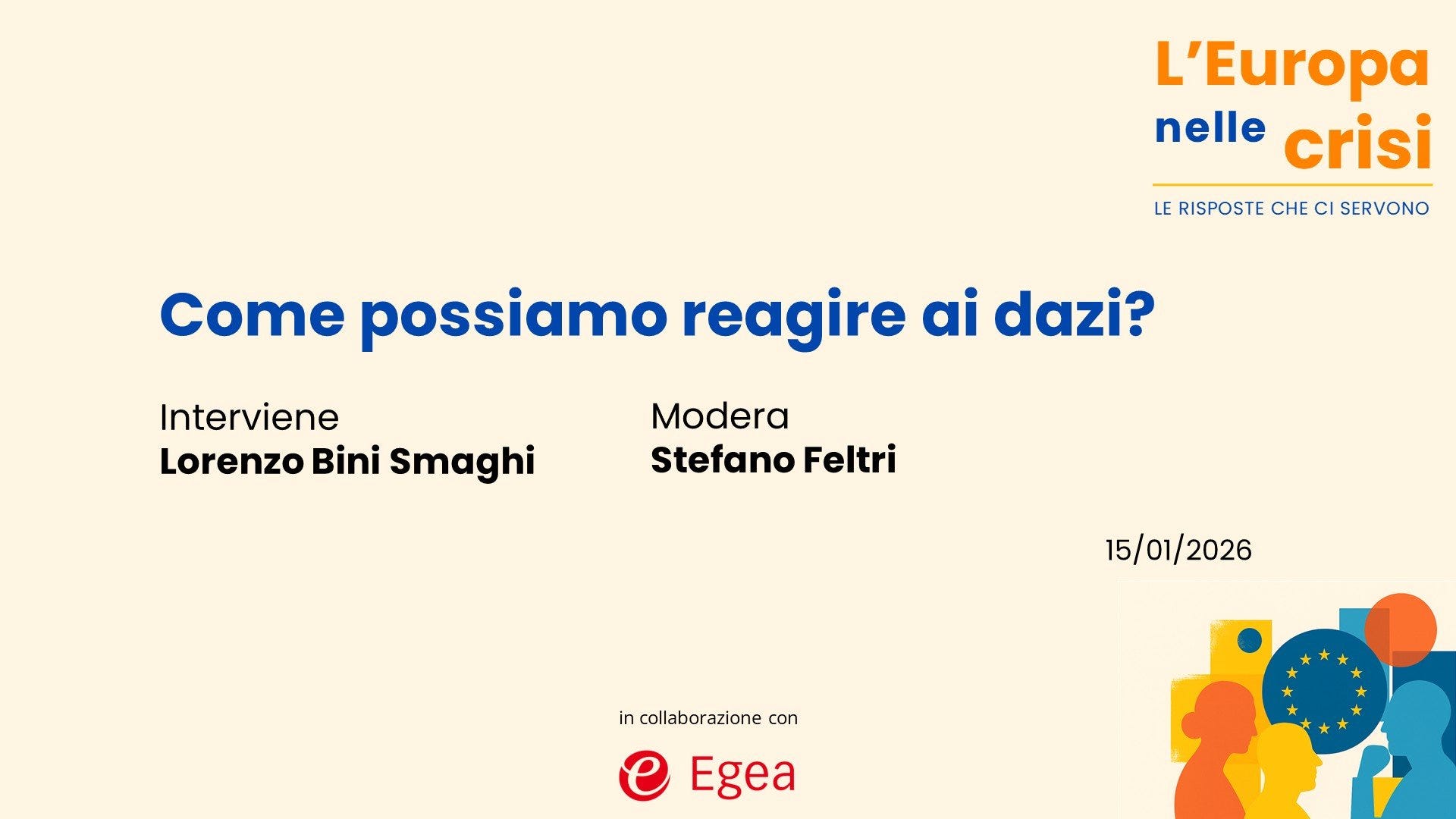
Sala Lettura EGEA, v.le Bligny 22, 20122 Milano
15/01/2026, 18:00 - 15/01/2026, 19:00
Per iscriverti all’evento clicca qui sotto

The IEP@BU Mission
Founded by Bocconi University and the Institute Javotte Bocconi, the Institute for European Policymaking @ Bocconi University combines the analytic rigor of a research institute, the policy impact of a think tank, and the facts-based effort of raising public opinion’s awareness about Europe through outreach activities. The Institute, fully interdisciplinary, intends to address the multi-fold obstacles that usually stand between the design of appropriate policies and their adoption, with particular attention to consensus-building and effective enforcement.
The Institute’s mission is to conduct, debate, and disseminate high-quality research on the major policy issues facing Europe, and the EU in particular, its Member States, and its citizens, in a rapidly changing world.
It is independent of any business or political influence.
The IEP@BU Management Council
Catherine De Vries, IEP@BU President
Daniel Gros, IEP@BU Director
Sylvie Goulard, IEP@BU vice-President, Professor of Practice in Global Affairs at SDA Bocconi School of Management
Silvia Colombo, IEP@BU Deputy Director
Carlo Altomonte, Associate Professor at Bocconi University and Associate Dean for Stakeholder Engagement Programs at SDA Bocconi School of Management
Arnstein Aassve, Professor in Demography at Bocconi University
Valentina Bosetti, professor of Environmental and Climate Change Economics at Bocconi University
Elena Carletti, Dean for Research and Professor of Finance at Bocconi University
Eleanor Spaventa, Professor of European Union Law at Bocconi Law School