


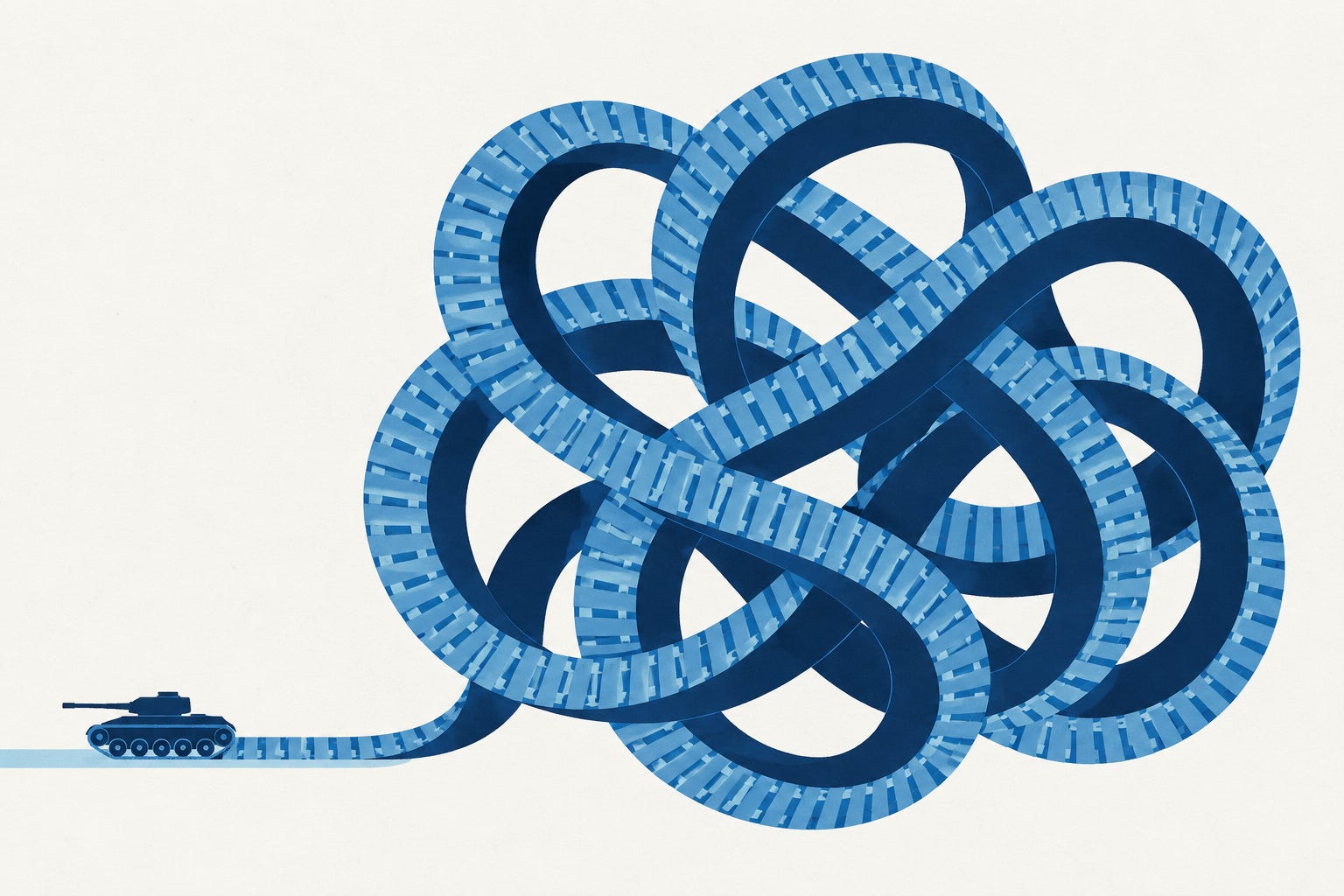
While the beginning of a war can be predicted, or is at least foreseeable, the same cannot be said of its course, let alone its end.
Nathalie Tocci
IEP@BU does not express opinions of its own. The opinions expressed in this publication are those of the authors. Any errors or omissions are the responsibility of the author
We know how wars begin, but not how they end. From the forgotten lessons of September 11 and the “forever wars” in Afghanistan and Iraq to Russia’s invasion of Ukraine and the wars in the Middle East, history is not repeating itself. It is getting worse.
Sometimes, events can be anticipated. When one country, Russia, deploys 200,000 troops on the border of another, Ukraine, an invasion is anything but unforeseeable, although far too many refused to see it coming.
Likewise, when a superpower, the United States, moves an aircraft carrier from the Pacific to the Gulf, peace talks are likely to be a façade, and the die may already have been cast for a military attack on Iran.
Rewind a quarter of a century: when al-Qaeda attacked America on September 11 2001, a US military response was inevitable. An Israeli military response in the Gaza Strip was equally inevitable 22 years later, following the Hamas attacks of October 7 2023.
But while the beginning of a war can be predicted, or is at least foreseeable, the same cannot be said of its course, let alone its end.
After the September 11 attacks, the United States did not respond immediately: it spent weeks building international consensus.
Donald Trump does not like to recall this, but the only time Nato’s Article 5 was invoked, it was Washington that asked its allies for help, which they did not hesitate to provide.
That consensus subsequently unravelled when the war in Afghanistan was followed by the war in Iraq, justified by the lie about weapons of mass destruction. Initially, however, US action was far more multilateral and grounded in consensus than is remembered today.
Israel’s response to October 7 was very different. Joe Biden’s warning went unheeded. One of the most sincerely, if not blindly, pro-Israel US presidents, he urged Israel not to repeat America’s mistakes in the war on terror.
In Iraq, America made the mistake of unilateralism, launching an illegal invasion without the support of many allies: a war that fractured both the transatlantic relationship and Europe itself.
America committed war crimes, with images of Guantánamo and Abu Ghraib etched into the memory of an entire generation, dealing a devastating blow to its international standing.
Finally, it confused short-term operational results with strategic outcomes: the former were impressive, given America’s unrivalled military capabilities; the latter were catastrophic.
Israel has disregarded these lessons, becoming increasingly isolated and convinced, in defiance of history, that it can survive in the long term as a small Sparta in the Middle East.
Many regard Israel as guilty of genocide in Gaza, a finding the International Court of Justice may eventually reach as well. It invades, razes and occupies, yet fails to achieve its stated objectives: Hamas, Hezbollah and the Iranian regime are still there.
Israel is not alone in refusing to listen. Vladimir Putin has learnt nothing either. Convinced that he would win the war in Ukraine within days, he now finds himself, almost five years later, with a little more Ukrainian territory but more than 1.5 million Russian soldiers killed or wounded.
Perhaps, for Putin, this is no bad thing: a long war was not his initial intention, but the continuation of the conflict, not only against Ukraine but against Europe, has become the cornerstone of his repressive regime.
His regime might survive the end of the hot phase of the war in Ukraine by turning into a gigantic North Korea. But it would not survive a genuine end to the war against Europe, on which its very existence now depends.
Most surprising, however, is that America itself refuses to heed its own lessons. When Washington embarked on the war in Vietnam, it did not believe it would become so long and bloody.
The US evacuation from Saigon in 1975 was echoed 46 years later in the flight from Kabul, abandoned to the Taliban.
After that humiliation, it seemed that the lesson had at least been learnt once and for all: we know how wars begin, but not how they end, and they can rarely be brought to a swift conclusion with a wave of a magic wand. Opposition to “forever wars” has been a cornerstone of MAGA, embodied by Trump.
The war against Iran was supposed to be different: a swift, powerful blow, and the regime would implode.
For a while, some believed it, financial markets foremost among them, which partly explains why oil prices remained relatively contained.
As the months passed, we began to take Trump’s announcements of an imminent end to the war with a pinch of salt.
Then he stopped believing them himself. He now says the war in the Middle East will end after the midterm elections. It may not. When America attacked first Afghanistan and then Iraq, it did not expect to remain militarily entangled for 20 years.
Today, likewise, we refuse to see that the wars in Europe and the Middle East do not merely bear the tragic resemblance of the forever wars of the past. They are far worse.
A previous version of this article was published by the Italian daily La Stampa
Nathalie Tocci
Senior Fellow

Nathalie Tocci is a senior fellow of the Institute for European Policymaking at Bocconi University. She has been Director of the Istituto Affari Internazionali from 2017 to 2026. She has been Special Advisor to EU High Representatives Federica Mogherini and Josep Borrell. In that capacity, she wrote the European Global Strategy and worked on its implementation. She is also the James Anderson professor of the practice at John Hopkins School of Advanced International Studies.
IEP@BU Publications
Policy Brief - Europe as Central Power

Europe should remember that self-restraint is the road to becoming a central power, not just as it leads the like-minded middle powers but also as it partners with others
Ukraine’s AfD Insurance Policy

Germany is the largest funder of Ukraine’s defence in Europe. If Germany walks away, the rest of the EU cannot make up the difference. It has neither the money nor the cohesion
More Europe in Defence: Three Pathways

CEPS, RUSI, Clingendael and IEP Bocconi have joined forces to substantiate what politicians often casually refer to as a European pillar of NATO – though few can say what this means in practice or whether it would offer a credible deterrent. This report outlines three possible pathways to shore up Europe’s defences: a more European NATO; a new European …
Europe Must Break With ‘Juste Retour’ to Scale up its Defence

SAFE should be redesigned to reward procurement models that deliver speed at scale: batch orders; single configurations (to avoid “national variants” that destroy scale and interoperability); and contestable subcontracts to widen supply chains across Europe. The objective is resilience: more suppliers, more capacity, faster output, and fewer political …
Policy Brief - Paying for the Critical Minerals of the Low-Carbon Transition

The low-carbon energy transition is highly dependent on critical minerals (CMs), whose prices are expected to increase. This raises the question of whether higher CM prices could improve fiscal revenues in low- and middle-income countries (LMICs) that export these minerals, and whether such gains would come at the cost of reduced affordability of low-ca…
Working Paper - The Laboratory of The World?

Based on our metric, we find that on average, the US is a more attractive location for R&D than the EU. However, this is not the case for China, which has the highest R&D ratio. However, we show that the primacy of China is entirely driven by the manufacturing sector. When the latter is left out, the US has the highest ratio, at least until 2019, when t…

The IEP@BU Mission
Founded by Bocconi University and Institute Javotte Bocconi, the Institute for European Policymaking @ Bocconi University combines the analytic rigor of a research institute, the policy impact of a think tank, and the facts-based effort of raising public opinion’s awareness about Europe through outreach activities. The Institute, fully interdisciplinary, intends to address the multi-fold obstacles that usually stand between the design of appropriate policies and their adoption, with particular attention to consensus building and effective enforcement.
The Institute’s mission is to conduct, debate, and disseminate high-quality research on the major policy issues facing Europe, and the EU in particular, its Member States and its citizens, in a rapidly changing world.
It is independent of any business or political influence.
The IEP@BU Management Council
Catherine De Vries, IEP@BU President
Daniel Gros, IEP@BU Director
Sylvie Goulard, IEP@BU vice-President, Professor of Practice in Global Affairs at SDA Bocconi School of Management
Silvia Colombo, IEP@BU Deputy Director
Carlo Altomonte, Associate Professor at Bocconi University and Associate Dean for Stakeholder Engagement Programs at SDA Bocconi School of Management
Arnstein Aassve, Professor in Demography at Bocconi University
Valentina Bosetti, professor of Environmental and Climate Change Economics at Bocconi University
Elena Carletti, Dean for Research and Professor of Finance at Bocconi University
Eleanor Spaventa, Professor of European Union Law at Bocconi Law School
Nathalie Tocci, IEP@BU Senior Fellow
Good article, but you need to make one important correction - the US did not Invoke or request Article 5 after 9/11. In fact then Secretary of State Colin Powell was opposed to the idea. The NATO North Atlantic Council voted in support of the idea, reportedly with the support of the British.
This does not diminish NATO’s Europe’s contributions to the military effort following 9/11. It is however important in the context of today’s geopolitical discourse, and in particular what the US would do in a potential conflict between Europe and Russia.
Ben poche guerre del passato sono state combattute e sono finite nei modi e nei tempi immaginati da chi le aveva iniziate. C'è da rimanere basiti nel constatare che il medesimo errore si ripete da migliaia di anni. Eppure lo studio della storia militare è da sempre una delle materie di studio fondamentali nelle accademie militari.