


The combination of a large economy, strong trade performance and solid research capacity forms the basis of European soft power. But these assets must be leveraged through alliances with like-minded middle powers — such as Canada, Australia, Japan and, closer to home, the UK — that can help reduce Europe’s vulnerabilities
Daniel Gros, and Agathe Demarais
IEP@BU does not express opinions of its own. The opinions expressed in this publication are those of the authors. Any errors or omissions are the responsibility of the author
by Agathe Demarais, and Daniel Gros
In late April the US and the EU announced a deal on critical minerals, with plans to co-operate on standards, investments, and price floors. Such a scheme adds to a recent flurry of critical minerals-themed legislation that aims to reduce reliance on Chinese supplies of critical minerals in a bid to boost economic security—the buzzword of the day in Brussels, Tokyo, and Washington.
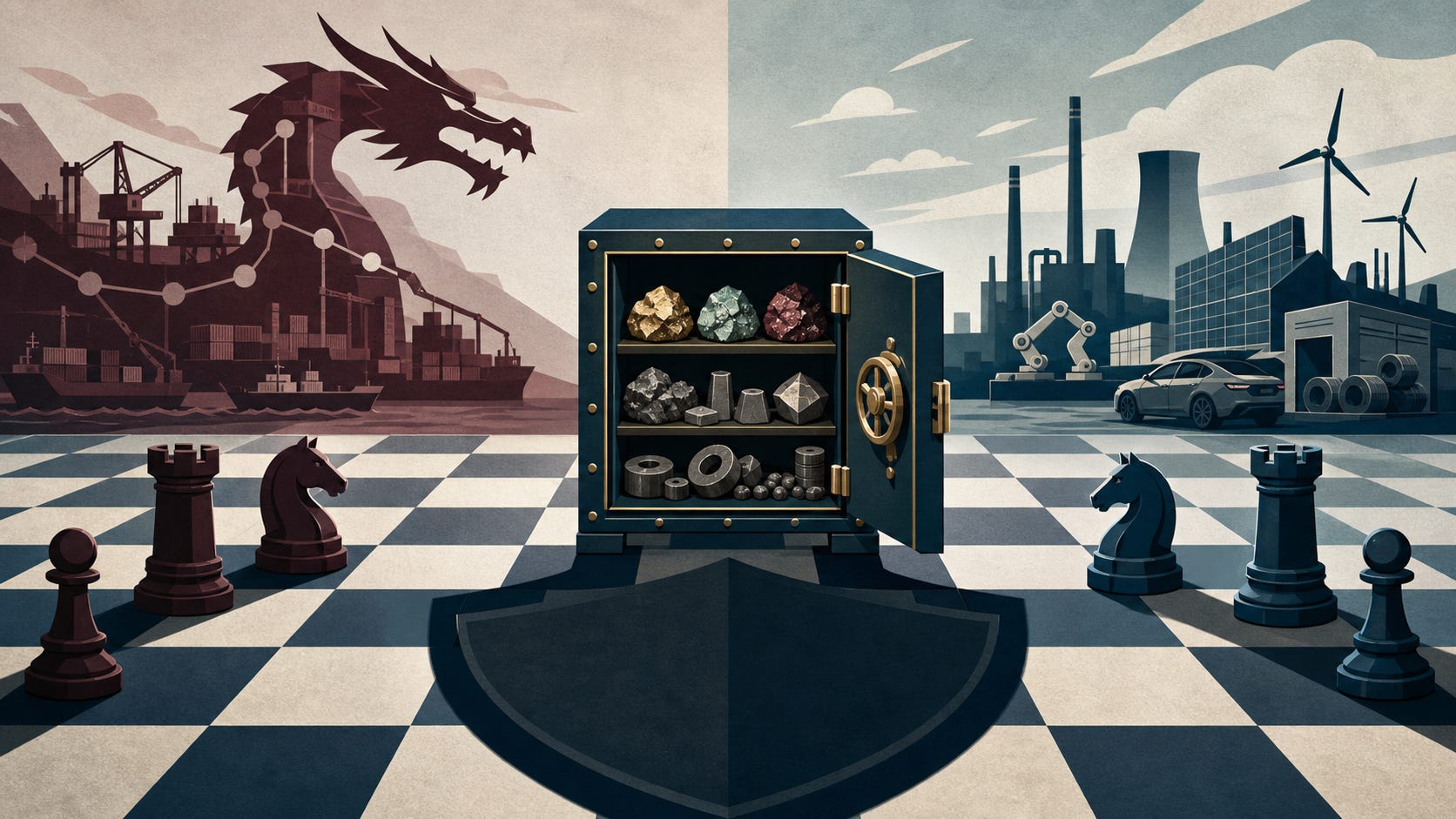
Such steps are welcome, but they will probably do too little and almost certainly come to fruition too late to reduce the risks that reliance on Chinese-sourced minerals poses. Not all is lost, though, and Western economies still have a fast, low-cost, and effective option to tackle this challenge: setting up stockpiles of critical minerals, buying them at a low price when Chinese firms flood the global market and then selling them for a profit when Beijing tightens supply.
Countering China’s Dominance
China’s stronghold over critical minerals is well known. Chinese firms control around 60 percent of the global mining capacity to produce raw minerals and they process around 90 percent of these metals. In recent months, Beijing’s apparent willingness to weaponize access to critical minerals has pushed Western economies to announce a raft of measures to reduce dependency on Chinese minerals.
These broadly revolve around three pillars. First, building mines domestically. This is the point of many of the critical minerals-linked initiatives that have popped up lately, including the EU’s Critical Raw Materials Act. Second, recycling and urban mining. This entails recovering critical minerals from end-of-life electric vehicles, electronics, and batteries. Third, friend-shoring through the conclusion of deals with producing economies like Australia, Canada, and Kazakhstan.
There are several reasons why this approach will not be enough. For a start, the timeline does not add up. In Europe, building a new mine can take 15 to 20 years from discovery to production. This means that new projects will come online only in the 2040s. Similarly, setting up a recycling ecosystem for critical minerals will take time; recycling rates for rare earth metals currently stand below 1 percent. Furthermore, friend-shoring deals will do nothing to lessen global dependence on Chinese processing capacity. Besides, recent US deals with the shaky regimes of the Democratic Republic of Congo (DRC), Zambia, or Pakistan may be prone to sudden reversals. Last but not least, private sector buy-in is hard to secure. Many Western mining executives openly wonder whether demand for higher-priced, G7-sourced minerals will be forthcoming. Without such reassurance, making multi-billion-dollar investments is difficult to justify.
Crucially, the narrative around China’s critical minerals leverage may well be missing the point—making current fixes ill-suited. The mainstream view is that Beijing could pull the trigger at any time on an export ban on critical minerals. The reality, however, may well be more nuanced.
Curbing exports of critical minerals would be highly painful for Beijing, as Western dependence on China for critical minerals runs both ways.
Many of the rare earths that China ships to America find their way back to Chinese soil in the form of US-processed compounds, which Chinese firms need to build electric vehicles and electronic goods; in 2024 China absorbed around three-quarters of US exports of such compounds.
What’s more, an outright ban on exports of critical minerals is a weapon that China can use only once. Such a measure would signal that China is an unreliable supplier and lead to a flurry of new mining investments globally.
A Quicker and Cheaper Way
With this in mind, a different approach is likely to work much better. It would be quick to implement, cheap to develop, and highly effective, namely: building a stockpile of critical minerals.
A critical minerals stockpile would protect Western economies against geopolitical supply shocks. The scheme would work in two phases.
First, buy cheap. When China dumps low-priced minerals in a bid to kill Western mining firms, the stockpile would absorb excess supply—building reserves at rock-bottom prices and neutralizing China’s flooding strategy.
Such a slow, counter-cyclical accumulation of minerals would serve an important side goal: It would avoid fueling a rise in prices and thus keep stockpiling costs modest.
This is a crucial point. On both sides of the Atlantic, the annual value of imports for most critical minerals stands at just a few hundred million dollars, a rounding error for GDPs and budgets. Even accounting for storage and depreciation costs, this means that a stockpile could cost only a fraction of the billions that are now being spent on building mines domestically.
Second, the stockpile would serve as insurance in a crisis. If China ever pulls the trigger on an export ban, thus fueling expectations of a price spike and global shortages, the stockpile would sell inventories to the private sector.
In doing so, the stockpile would act both as an insurance policy protecting private firms and as a profit-generating mechanism for the states that set it up, capturing at least part of the price premium that commodity traders would otherwise earn.
As an added benefit, the stockpile would also act as a deterrent against potential Chinese plans to ban the exports of critical minerals. Unlike vague government pledges to boost supply security, a tangible stockpile cannot be dismissed as a Western bluff. If Beijing knows that minerals-hungry economies like the US or the EU have reserves they can easily tap into, then the threat of an export ban quickly loses bite.
Skeptics often wonder whether China would allow Western economies to set up a critical minerals stockpile. This concern is valid, as Beijing has long insisted that its critical minerals exports cannot be stockpiled.
However, other factors suggest that these reservations may be overcome.
China would probably find it hard to monitor the ultimate use of every single ton of critical minerals exports. Minerals are fungible, trading networks can be opaque and third-country processors like Malaysia, Vietnam or Kazakhstan would offer channels for resales.
The slow, steady accumulation strategy means that Western economies could source supplies from non-Chinese suppliers if need be. And any Chinese pushback would be self-defeating: Blocking sales to stockpilers would only accelerate Western diversification and stockpiling plans.
Western economies would not be starting from scratch when setting up a critical minerals stockpile. Members of the International Energy Agency (IEA) hold oil stocks representing the equivalent of at least 90 days of imports, for instance.
The largest-ever release took place just a few weeks ago, in mid-March, when IEA members released 400 million barrels of oil after a blockade in the Strait of Hormuz disrupted around one-quarter of global seaborne oil trade.
All six releases were triggered by the same type of supply shock that a critical minerals stockpile would guard against, that is to say conflicts—the Gulf War in 1991, the Libya civil war in 2011, Russia’s full-scale invasion of Ukraine in 2022 (two releases) and war in Iran this year—or natural disasters like Hurricanes Katrina and Rita that hit oil production in the Gulf of Mexico in 2005.
Two other examples solidify the proof of concept for a critical minerals stockpile.
The first comes from Japan, whose advanced-magnet industry depends on rare earth supplies. The country was a pioneer in recognizing the importance of critical minerals, setting up a stockpile in 1983. This proved to be a wise move: The mechanism helped to protect Japanese manufacturers when China temporarily cut off exports of rare earths nearly three decades later following a territorial dispute.
The second proof of concept stems from the United States, where the US National Defense Stockpile has managed to accumulate critical materials, including copper, nickel, lithium, and 16 rare earth elements, since 1939. The tool is defense-oriented, but it illustrates how Western economies can overcome the logistical difficulties of buying, storing, and managing critical minerals, even over decades.
Three Concrete Advantages
The case for a critical minerals stockpile does not rest on precedents alone, however. The mechanism carries three concrete advantages that make it a particularly well-suited response to the critical minerals challenge that Western economies are facing.
Building a critical minerals stockpile would come with several benefits. The first is obvious: Storage can begin quickly, making the stockpile a fast, actionable fix against Chinese threats to cut off exports. Western economies could sign contracts within weeks and see meaningful inventories pile up within months. A stockpile would not replace much-needed private commitments to open new mines, but it would help to buy time for such investments to take place.
Such a speed advantage would also send an immediate deterrence signal to Beijing. Unlike a government pledge, a mining permit, or a bilateral supply deal that can all take years to materialize and may prove ineffective, a stockpile can become operational within months. In a geopolitical environment where deterrence is increasingly about credible commitment, such visibility matters.
Second, setting up the stockpile does not require buy-in from the private mining sector.
Many G7 mining firms have deep-seated reservations about making costly investments at a time when long-term G7 demand for higher-priced (read: non-Chinese) minerals remains highly uncertain. A stockpile would help to sidestep these challenges: The scheme would buy minerals on open markets to serve critical minerals consumers, with no need to secure buy-in from critical minerals producers.
Of course, the point is not to exclude private firms from the process. Instead, the idea is to let the public sector step in to respond to a challenge that it is probably best placed to tackle. Attracting private investment over time remains the ultimate goal, and it is achievable in parallel.
Third, the stockpile would serve as a useful co-ordination springboard to reduce dependency on Chinese-sourced critical minerals either at the EU or, ideally, at the G7 level down the road. Such a plan would be an ambitious endeavor, not least on the governance front.
Besides, current European and Japanese doubts around US reliability would be a key obstacle. As a first step, the EU could start with setting up its own stockpile as a trial before inviting other G7 members to join at a later stage. The point would not be to set up a perfect, multilateral institution from day one.
Instead, the goal would be to establish a working mechanism that could be refined over time as other members opt in and join forces—sowing the seeds for concrete co-operation in a key field for Western economies at a time when G7 states urgently need to find issues they can rally around.
A Good Way to Buy Time
A transatlantic deal on critical minerals is welcome, but the impact of setting up joint standards, investments, and price floors may take years to bear fruit. In the meantime, building a critical minerals stockpile would serve as a low-cost fix to neutralize China’s two-pronged strategy of flooding the global market with cheap minerals and using its stronghold over the sector as leverage over America and Europe.
Such a stockpile could be up and running within months, giving Western policymakers a tangible deliverable and sending an immediate deterrence signal to Beijing.
The rarest commodity in Western critical minerals policy today may not be scandium, lithium or dysprosium. Instead, it may well be time. A stockpile would not be a magic fix, but it would at least help Western economies to buy time on the critical minerals front.
This article was originally published by Internationale Politik Quarterly
Daniel Gros

Daniel Gros is a Senior Fellow at the Institute for European Policymaking @ Bocconi University, where he served as founding Director from 2023 to 2026.
Between 2020 and 2022 he was Distinguished Fellow and Member of the Board of the Centre for European Policy Studies (CEPS). Before that, was the director of CEPS from 2000. In 2020, he held a Fulbright fellowship and was a visiting professor at the University of California, Berkeley. In March-June, 2022 he was visiting Research Fellow at the Robert Schuman Centre of the European University Institute, Florence.
Agathe Demarais

Agathe Demarais is a senior policy fellow on geoeconomics and tech at the European Council on Foreign Relations. Her work focuses on the global economy, trade wars, sanctions, de-risking and export controls. Before joining ECFR, she was global forecasting director at the Economist Intelligence Unit. She is the author of *Backfire*, a book on the global ripple effects of sanctions and export controls.
IEP@BU Publications
Europe Must Break With ‘Juste Retour’ to Scale up its Defence

SAFE should be redesigned to reward procurement models that deliver speed at scale: batch orders; single configurations (to avoid “national variants” that destroy scale and interoperability); and contestable subcontracts to widen supply chains across Europe. The objective is resilience: more suppliers, more capacity, faster output, and fewer political …
Policy Brief - Paying for the Critical Minerals of the Low-Carbon Transition

The low-carbon energy transition is highly dependent on critical minerals (CMs), whose prices are expected to increase. This raises the question of whether higher CM prices could improve fiscal revenues in low- and middle-income countries (LMICs) that export these minerals, and whether such gains would come at the cost of reduced affordability of low-ca…
Working Paper - The Laboratory of The World?

Based on our metric, we find that on average, the US is a more attractive location for R&D than the EU. However, this is not the case for China, which has the highest R&D ratio. However, we show that the primacy of China is entirely driven by the manufacturing sector. When the latter is left out, the US has the highest ratio, at least until 2019, when t…

The IEP@BU Mission
Founded by Bocconi University and Institute Javotte Bocconi, the Institute for European Policymaking @ Bocconi University combines the analytic rigor of a research institute, the policy impact of a think tank, and the facts-based effort of raising public opinion’s awareness about Europe through outreach activities. The Institute, fully interdisciplinary, intends to address the multi-fold obstacles that usually stand between the design of appropriate policies and their adoption, with particular attention to consensus building and effective enforcement.
The Institute’s mission is to conduct, debate, and disseminate high-quality research on the major policy issues facing Europe, and the EU in particular, its Member States and its citizens, in a rapidly changing world.
It is independent of any business or political influence.
The IEP Bocconi Management Council
Marta Cartabia
President
Sylvie Goulard
Vice-President
Paloma Lopez-Garcia
Director
Silvia Colombo
Deputy Director
Carlo Altomonte
Arnstein Aassve
Valentina Bosetti
Elena Carletti
Daniel Gros
Eleanor Spaventa
Nathalie Tocci
