



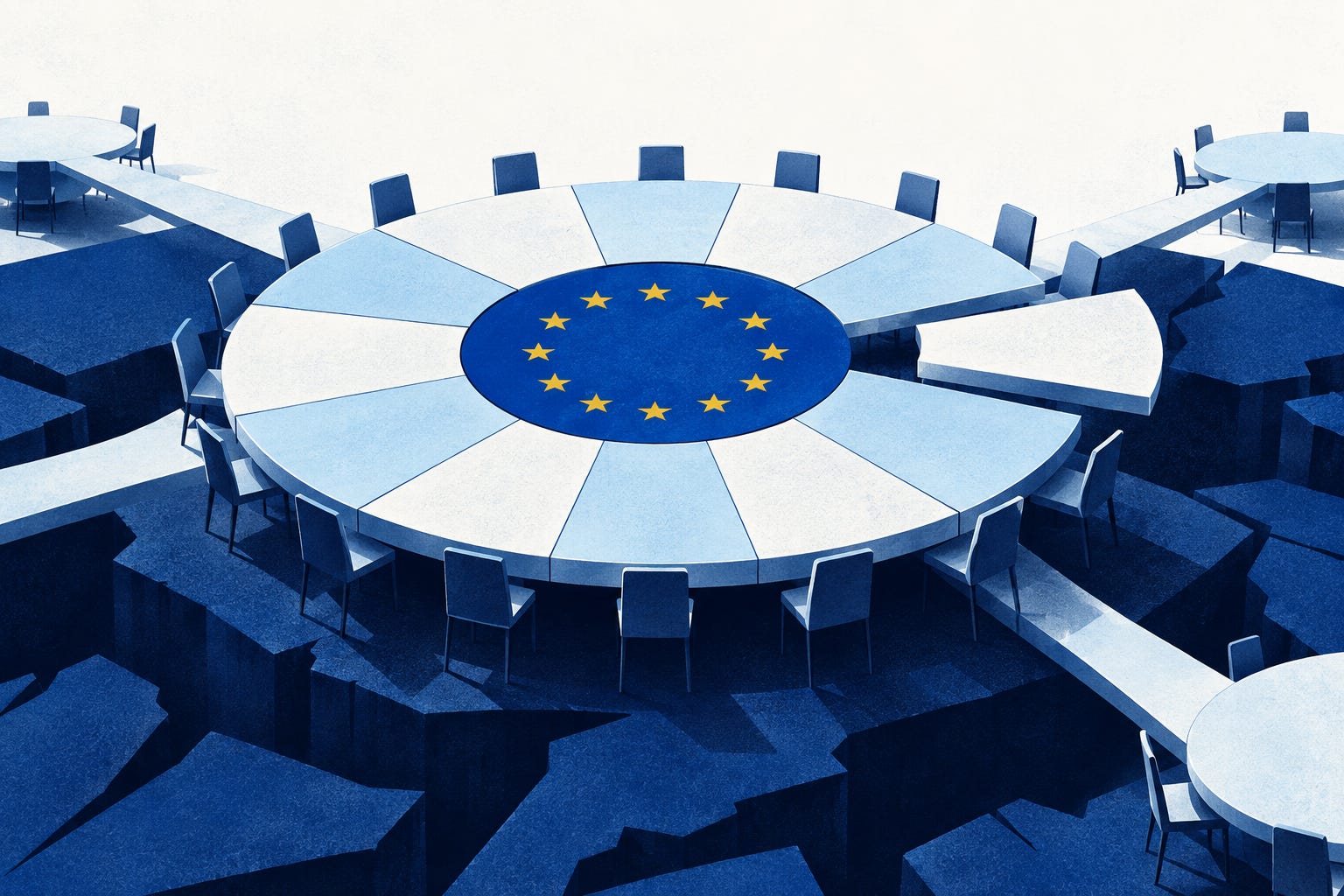
Europe should remember that self-restraint is the road to becoming a central power, not just as it leads the like-minded middle powers but also as it partners with others
Daniel Gros and Nathalie Tocci
IEP@BU does not express opinions of its own. The opinions expressed in this publication are those of the authors. Any errors or omissions are the responsibility of the author
The ideas at the heart of this policy brief will be discussed at the IEP Bocconi Annual Event in Milan on 18 November 2026.
Save the date
Download the Policy Brief

Executive Summary
Amidst growing great power rivalries and imperial designs, a vibrant debate about the role and responsibilities of middle powers has emerged.
The middle power debate has undergone a radical shift, tracking the convulsions of international relations, which often revolve around great power dynamics of cooperation and conflict.
It began as a discussion about the budding role of the Global South, amidst the growing confrontation between the Global West and the Global East.
Canadian Prime Minister Mark Carney, at the Davos 2026 conference, then reframed the middle power mission as a quest to save and re-imagine a rules-based international order.
Europe sits uneasily in this debate, seeing itself as too small if divided and too large if united, and unsure whether, how, and to what extent it should shed its traditional understanding as a principled global player and endorse the cruder transactional turn in international relations.
In this Policy Brief, we map the evolution of the middle power debate in time and space, pointing to its contradictions. We then turn to Europe: it is precisely in the reconciliation of these middle power contradictions that Europe can carve out its global role.
The European Union represents the only power whose economy is similar in size to that of the two superpowers, China and the US. This invites the temptation to use economic levers in a similar manner, unilaterally and without regard for the interests of others.
But this temptation should be resisted.
Europe should remember that self-restraint is the road to becoming a central power, not just as it leads the like-minded middle powers but also as it partners with others.
Recent events have amply demonstrated the limits of unrestrained hard power. Russia’s full-scale invasion of Ukraine and the US attack on Iran have clearly backfired. There is also little evidence that the wanton use of tariffs by the US has achieved much, apart from alienating allies.
The EU would do well to remember that this lesson applies to itself as well. Using tariffs, quotas and other ways to favour domestic manufacturers at the expense of potential allies and other partners leads to isolation that Europe can afford even less than the US or China, given that it has no levers of hard power.
The insight that restraint pays off is not new. During the so-called period of the warring states in China, the Tao school advised that a large power:
“Wins over smaller and weaker ones
With respect and appreciation.
Not threatened, smaller countries support and sustain the larger”
The EU is also uniquely placed to exercise global coalition building through strategic restraint because it is a community of rules and law. Without it, the continent would slip back into a Europe of nations, which is precisely what far-right forces in Europe and imperial aspirants in Moscow and Washington would like it to be.
If Europe abandons its principles and laws, rather than working to reassert them alongside other small and middle powers, it will not emerge as a muscular global player but will instead be pulled apart by predatory powers like Russia and the US.
To do so, it should overcome the middle power challenge, forging a differentiated strategy towards it. Provided it stands united (admittedly a big if), Europe can aspire to become a central power, leading like-minded middle powers.
The EU cannot replace the United States as global hegemon. But it can offer something more useful for the present moment: leadership without domination.
That means giving like-minded partners a voice before decisions are taken, treating their inputs as part of European resilience, and avoiding unilateral measures that export costs to allies. Such restraint may look like a concession. It is not. In a world of predatory powers, Europe’s long-term interest lies in becoming first among equals.
And while it does this, it should partner as one among equals with other small, middle and large powers in the Global South that know, or have now been reminded of, the existential importance of having basic norms, laws and institutions governing the international system.
Yes, those norms will not be as thick as those regulating relations between like-minded middle powers, but they will be essential, in fact existential. And while norms will occasionally be violated, including by Europeans, it is way better to affirm rules and create mechanisms to implement them than meekly accept to dispense with them altogether.
Daniel Gros
Senior Fellow

Daniel Gros is a Senior Fellow at the Institute for European Policymaking @ Bocconi University, where he served as founding Director from 2023 to 2026.
Between 2020 and 2022 he was Distinguished Fellow and Member of the Board of the Centre for European Policy Studies (CEPS). Before that, was the director of CEPS from 2000. In 2020, he held a Fulbright fellowship and was a visiting professor at the University of California, Berkeley. In March-June, 2022 he was visiting Research Fellow at the Robert Schuman Centre of the European University Institute, Florence.
Nathalie Tocci
Senior Fellow

Nathalie Tocci is a senior fellow of the Institute for European Policymaking at Bocconi University. She has been Director of the Istituto Affari Internazionali from 2017 to 2026. She has been Special Advisor to EU High Representatives Federica Mogherini and Josep Borrell. In that capacity, she wrote the European Global Strategy and worked on its implementation. She is also the James Anderson professor of the practice at John Hopkins School of Advanced International Studies.
IEP@BU Publications
Ukraine’s AfD Insurance Policy

Germany is the largest funder of Ukraine’s defence in Europe. If Germany walks away, the rest of the EU cannot make up the difference. It has neither the money nor the cohesion
More Europe in Defence: Three Pathways

CEPS, RUSI, Clingendael and IEP Bocconi have joined forces to substantiate what politicians often casually refer to as a European pillar of NATO – though few can say what this means in practice or whether it would offer a credible deterrent. This report outlines three possible pathways to shore up Europe’s defences: a more European NATO; a new European …
Europe Must Break With ‘Juste Retour’ to Scale up its Defence

SAFE should be redesigned to reward procurement models that deliver speed at scale: batch orders; single configurations (to avoid “national variants” that destroy scale and interoperability); and contestable subcontracts to widen supply chains across Europe. The objective is resilience: more suppliers, more capacity, faster output, and fewer political …
Policy Brief - Paying for the Critical Minerals of the Low-Carbon Transition

The low-carbon energy transition is highly dependent on critical minerals (CMs), whose prices are expected to increase. This raises the question of whether higher CM prices could improve fiscal revenues in low- and middle-income countries (LMICs) that export these minerals, and whether such gains would come at the cost of reduced affordability of low-ca…
Working Paper - The Laboratory of The World?

Based on our metric, we find that on average, the US is a more attractive location for R&D than the EU. However, this is not the case for China, which has the highest R&D ratio. However, we show that the primacy of China is entirely driven by the manufacturing sector. When the latter is left out, the US has the highest ratio, at least until 2019, when t…
The IEP@BU Mission
Founded by Bocconi University and Institute Javotte Bocconi, the Institute for European Policymaking @ Bocconi University combines the analytic rigor of a research institute, the policy impact of a think tank, and the facts-based effort of raising public opinion’s awareness about Europe through outreach activities. The Institute, fully interdisciplinary, intends to address the multi-fold obstacles that usually stand between the design of appropriate policies and their adoption, with particular attention to consensus building and effective enforcement.
The Institute’s mission is to conduct, debate, and disseminate high-quality research on the major policy issues facing Europe, and the EU in particular, its Member States and its citizens, in a rapidly changing world.
It is independent of any business or political influence.
The IEP@BU Management Council
Catherine De Vries, IEP@BU President
Daniel Gros, IEP@BU Director
Sylvie Goulard, IEP@BU vice-President, Professor of Practice in Global Affairs at SDA Bocconi School of Management
Silvia Colombo, IEP@BU Deputy Director
Carlo Altomonte, Associate Professor at Bocconi University and Associate Dean for Stakeholder Engagement Programs at SDA Bocconi School of Management
Arnstein Aassve, Professor in Demography at Bocconi University
Valentina Bosetti, professor of Environmental and Climate Change Economics at Bocconi University
Elena Carletti, Dean for Research and Professor of Finance at Bocconi University
Eleanor Spaventa, Professor of European Union Law at Bocconi Law School
Nathalie Tocci, IEP@BU Senior Fellow
Just as within the EU, where sovereignty is augmented by being shared, by sharing decisions with other powers in the world, Europe’s soft power is increased at no military cost.
I was struck by the comparison between Russia’s and US/Isreali actions in trying to limit the sovereignty of another power at enormous cost to all concerned, which had previously occurred to me. Whereas far less sympathique to the Iranian regime (compared to the Ukrainian), why wouldn’t they choose guns over butter when they have been interfered with so much by outside powers, most egregiously perhaps in the overthrow of their democratic government in 1953, but repeatedly both before and since.
Hahaha - a kingdom of the global south, what does the globalist offer, more of a failing system? South America on it's way to join the USA global West, including Cuba and Brazil. The Indian ship has sailed, only Africa is left, haven't you recently let them out of your colonial system, now you want them back?