

More Debt or Less Security?
SAFE loans and the politics of European defence: Italy’s (and the EU’s) dilemma

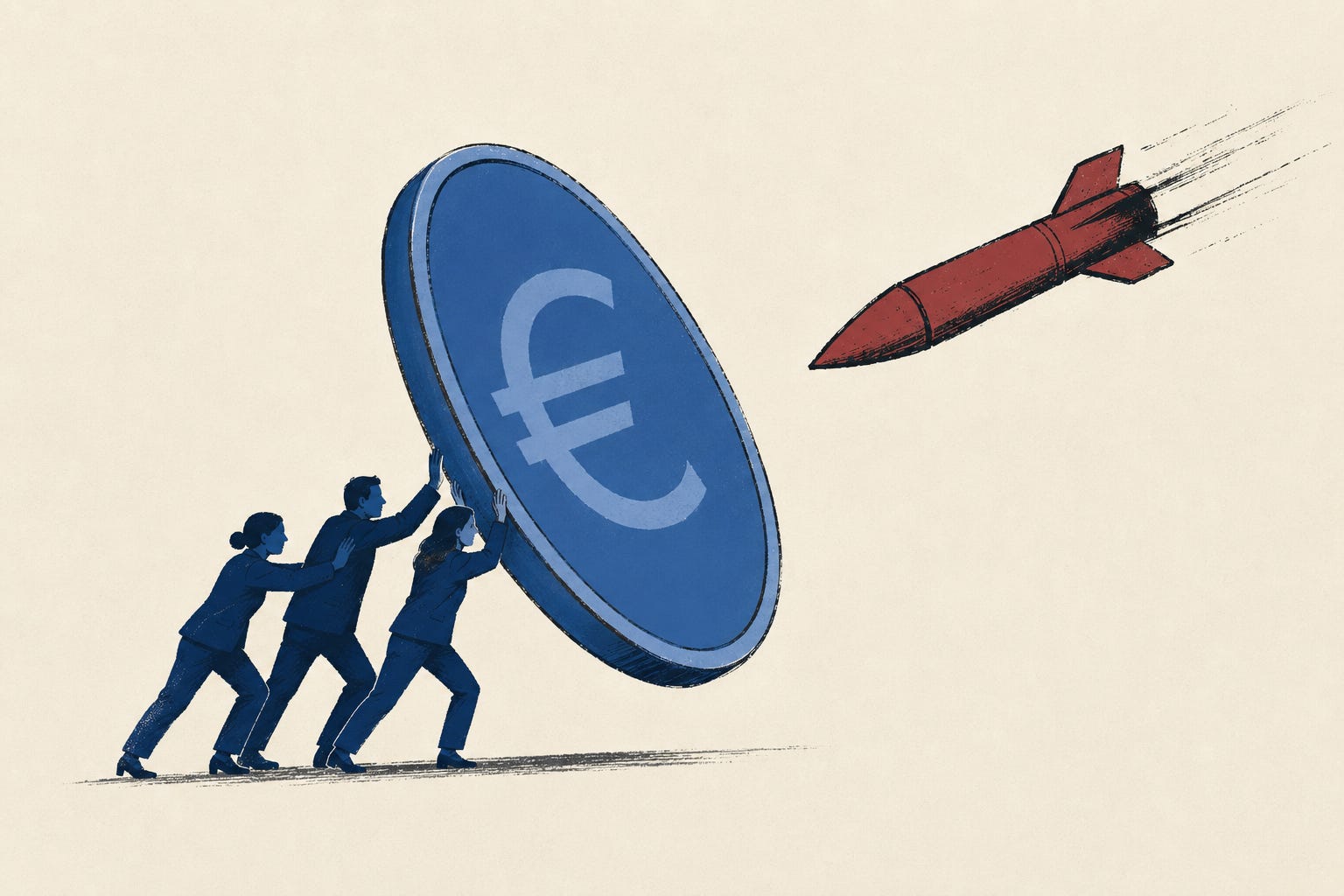
The EU’s new defence loans instrument shows how far European funding has evolved since the pandemic, while revealing that, regardless of the perceived urgency, highly indebted Member States continue to face significant political and fiscal constraints in taking on additional debt for defence and security
IEP@BU does not express opinions of its own. The opinions expressed in this publication are those of the authors. Any errors or omissions are the responsibility of the author
By Rosalba Famà
The debate surrounding Italy’s participation in the European Union’s new Security Action for Europe (SAFE) instrument illustrates a broader constitutional and political paradox confronting European defence spending. While the creation of SAFE marks a significant constitutional innovation by enabling the Union to issue common debt to support Member States’ defence investments, the availability of additional resources does not automatically translate into political willingness to spend them.
To give an example, Italy presented a European Defence Industry Plan and requested almost €15 billion in loans under the SAFE instrument to boost its defence investments and transition towards meeting the targets agreed at the NATO summit in The Hague last year (the so called 5x5).
This plan and the financial envelope have already been approved by the Council of the European Union. Nevertheless, the Meloni government is currently renegotiating a much smaller amount - between €4 and €5 billion - essentially limiting the use of SAFE loans to projects already planned rather than launching a new wave of defence expenditure.
The reasons behind this cautious approach are revealing.
Contrary to what might be expected, the obstacle is not the availability of European financial support, but rather the domestic political costs associated with expanding military spending at a particularly sensitive moment.
In my recent article, Defence Loans and New Trajectories of EU Economic Integration: Are We SAFE?, I argue that SAFE represents a fundamental shift in the Union’s approach to economic integration.
Unlike previous instruments adopted under Article 122 TFEU, such as those adopted during the financial crisis (the EFSM), or during the Covid-19 crisis, like SURE or the European Recovery Instrument (the cornerstone of NextGenerationEU), SAFE is not designed to respond to an ongoing economic crisis or support States that face market exclusion.
Instead, SAFE uses common borrowing proactively to expand Member States’ fiscal space in pursuit of a strategic objective: European defence preparedness by 2030. This is aligned with the White Paper for a European Defence presented by the Commission and the High Representative for Foreign Affairs and Security Policy in March 2025.
The White Paper sets out a financial strategy to strengthen the EU’s deterrence capacity against external military threats, at a time of shifting balances within NATO and growing uncertainty about the credibility of its Article 5 collective-defence guarantee.
More broadly, SAFE shows that common debt is no longer merely an emergency response mechanism but has increasingly become a structural component of European public finances.
Yet the current Italian debate demonstrates that expanding national fiscal spaces, by leveraging the EU budget, is only one side of the equation.
SAFE undoubtedly lowers the financial barriers to defence investment by allowing some Member States to borrow on more favourable terms backed by the Union’s strong creditworthiness.
Indeed, these loans alleviate the burden of interest payments and mutualize the financial risk of defence-debt among all Member States, including those that have not requested SAFE support.
Currently, Austria, Germany, Ireland, Luxembourg, Malta, the Netherlands and Slovenia have not requested SAFE loans.
This shows a renewed spirit of solidarity in the EU (Article 122 TFEU).
As such, one of the central arguments advanced in my article is that SAFE should not be understood simply as another financial instrument. Rather, it reflects an evolving understanding of solidarity within the European Union.
Traditionally, financial solidarity was associated with helping Member States facing severe asymmetric economic shocks or financial crises.
SAFE instead embodies solidarity through preparedness, enabling Member States collectively to strengthen Europe’s security before a crisis fully materialises. It is not surprising that Poland, the Member State most exposed to Russian threats, is the largest beneficiary of SAFE loans.
However, SAFE does not resolve the political dilemma surrounding defence spending.
Italy currently remains subject to the Excessive Deficit Procedure under the reformed Stability and Growth Pact. Moreover, Italy’s economic growth forecasts have recently been revised downwards, further narrowing the government’s fiscal room for manoeuvre.
Although SAFE loans are specifically designed to facilitate defence investments, they still increase national public debt (unlike the grant component of Italy’s National Recovery and Resilience Plan under NextGenerationEU). For a government already committed to fiscal consolidation, additional borrowing inevitably requires difficult political choices and costs.
Every euro devoted to defence is a euro that is more difficult to simultaneously present as supporting households struggling with rising energy costs, public healthcare, education or other pressing social priorities (although, as Altomonte and Rauti have argued, these priorities are not necessarily incompatible).
This political tension has become particularly visible as Europe faces renewed volatility in energy markets and persistent inflationary pressures following the escalation of geopolitical conflicts. Governments are therefore confronted with polarizing narratives and attacked by competing parties.
The timing further complicates the picture. As upcoming elections begin to influence policy choices, governments become more reluctant to embrace large increases in military expenditure which require a long-term vision.
In this context, SAFE exposes an important limitation of this form of European financial solidarity: European loans can facilitate national spending, yet they still rely on additional debt to be ultimately repaid by the beneficiary State.
A dilemma emerges. On the one hand, the European Union increasingly frames defence as a European public good requiring collective investment and preparedness. On the other hand, the EU is offering ‘merely’ a way to facilitate national spending (also thanks to the activation of national escape clauses to deviate temporarily from the Stability and Growth Pact).
However, this does not create per se the political consensus necessary to justify an increase in spending before national electorates. This requires building domestic political legitimacy.
Overall, SAFE reveals that defence spending remains fundamentally constrained by national democratic politics and fiscal capacities and fully exposes the limits of the EU’s current approach to strengthening defence capabilities within the Member States.
This commentary builds on my article, Defence Loans and New Trajectories of EU Economic Integration: Are We SAFE?, published as part of the Special Issue EU Funding in Times of Geopolitical Turbulence: A Constitutional Laboratory, which I had the pleasure of co-editing with Prof. Eleanor Spaventa and Marco Fisicaro for the Maastricht Journal of European and Comparative Law.
The issue examines how EU funding has evolved following Russia’s war against Ukraine, focusing on SAFE, common borrowing, solidarity, conditionality, own resources and the future of the EU budget. Finally, it explores how the the changing geopolitical environment is reshaping not only EU financial instruments but also the constitutional foundations of European integration.
The issue is available online at https://journals.sagepub.com/toc/maaa/33/2
Rosalba Famà
PostDoc Fellow

Rosalba Famà is a lawyer and holds a PhD in legal studies from Bocconi University summa cum laude (2025). She is currently a postdoctoral researcher IEP@Bocconi. Her research interests regard the constitutional profiles of the European Union budget, the European Investment Bank, EU sustainable finance, and the Economic and Monetary Union.
She is also a contracted lecturer at Bocconi, where she teaches EU law, and a fellow of the Bocconi GREEN. In 2023, her research on European finances earned the recognition of a grant offered by the European Court of Auditors. Rosalba is also a selected member of the Spinelli Forum German-Italian Young Leader Forum and a recognized expert in geopolitics by ISPI (Institute of International Political Studies).
Her research has recently received a STAREBEI grant offered by the European Investment Bank.
IEP@BU Publications
More Europe in Defence: Three Pathways

CEPS, RUSI, Clingendael and IEP Bocconi have joined forces to substantiate what politicians often casually refer to as a European pillar of NATO – though few can say what this means in practice or whether it would offer a credible deterrent. This report outlines three possible pathways to shore up Europe’s defences: a more European NATO; a new European …
Europe Must Break With ‘Juste Retour’ to Scale up its Defence

SAFE should be redesigned to reward procurement models that deliver speed at scale: batch orders; single configurations (to avoid “national variants” that destroy scale and interoperability); and contestable subcontracts to widen supply chains across Europe. The objective is resilience: more suppliers, more capacity, faster output, and fewer political …
Policy Brief - Paying for the Critical Minerals of the Low-Carbon Transition

The low-carbon energy transition is highly dependent on critical minerals (CMs), whose prices are expected to increase. This raises the question of whether higher CM prices could improve fiscal revenues in low- and middle-income countries (LMICs) that export these minerals, and whether such gains would come at the cost of reduced affordability of low-ca…
Working Paper - The Laboratory of The World?

Based on our metric, we find that on average, the US is a more attractive location for R&D than the EU. However, this is not the case for China, which has the highest R&D ratio. However, we show that the primacy of China is entirely driven by the manufacturing sector. When the latter is left out, the US has the highest ratio, at least until 2019, when t…

The IEP@BU Mission
Founded by Bocconi University and Institute Javotte Bocconi, the Institute for European Policymaking @ Bocconi University combines the analytic rigor of a research institute, the policy impact of a think tank, and the facts-based effort of raising public opinion’s awareness about Europe through outreach activities. The Institute, fully interdisciplinary, intends to address the multi-fold obstacles that usually stand between the design of appropriate policies and their adoption, with particular attention to consensus building and effective enforcement.
The Institute’s mission is to conduct, debate, and disseminate high-quality research on the major policy issues facing Europe, and the EU in particular, its Member States and its citizens, in a rapidly changing world.
It is independent of any business or political influence.
The IEP@BU Management Council
Catherine De Vries, IEP@BU President
Daniel Gros, IEP@BU Director
Sylvie Goulard, IEP@BU vice-President, Professor of Practice in Global Affairs at SDA Bocconi School of Management
Silvia Colombo, IEP@BU Deputy Director
Carlo Altomonte, Associate Professor at Bocconi University and Associate Dean for Stakeholder Engagement Programs at SDA Bocconi School of Management
Arnstein Aassve, Professor in Demography at Bocconi University
Valentina Bosetti, professor of Environmental and Climate Change Economics at Bocconi University
Elena Carletti, Dean for Research and Professor of Finance at Bocconi University
Eleanor Spaventa, Professor of European Union Law at Bocconi Law School
Nathalie Tocci, IEP@BU Senior Fellow
 | A guest post by
|