

Foes’ with Benefits?
The shared opposition of environmentalists and farmers to the EU-Mercosur trade deal reflects concerns about economic liberalization at the expense of ecological and social equity


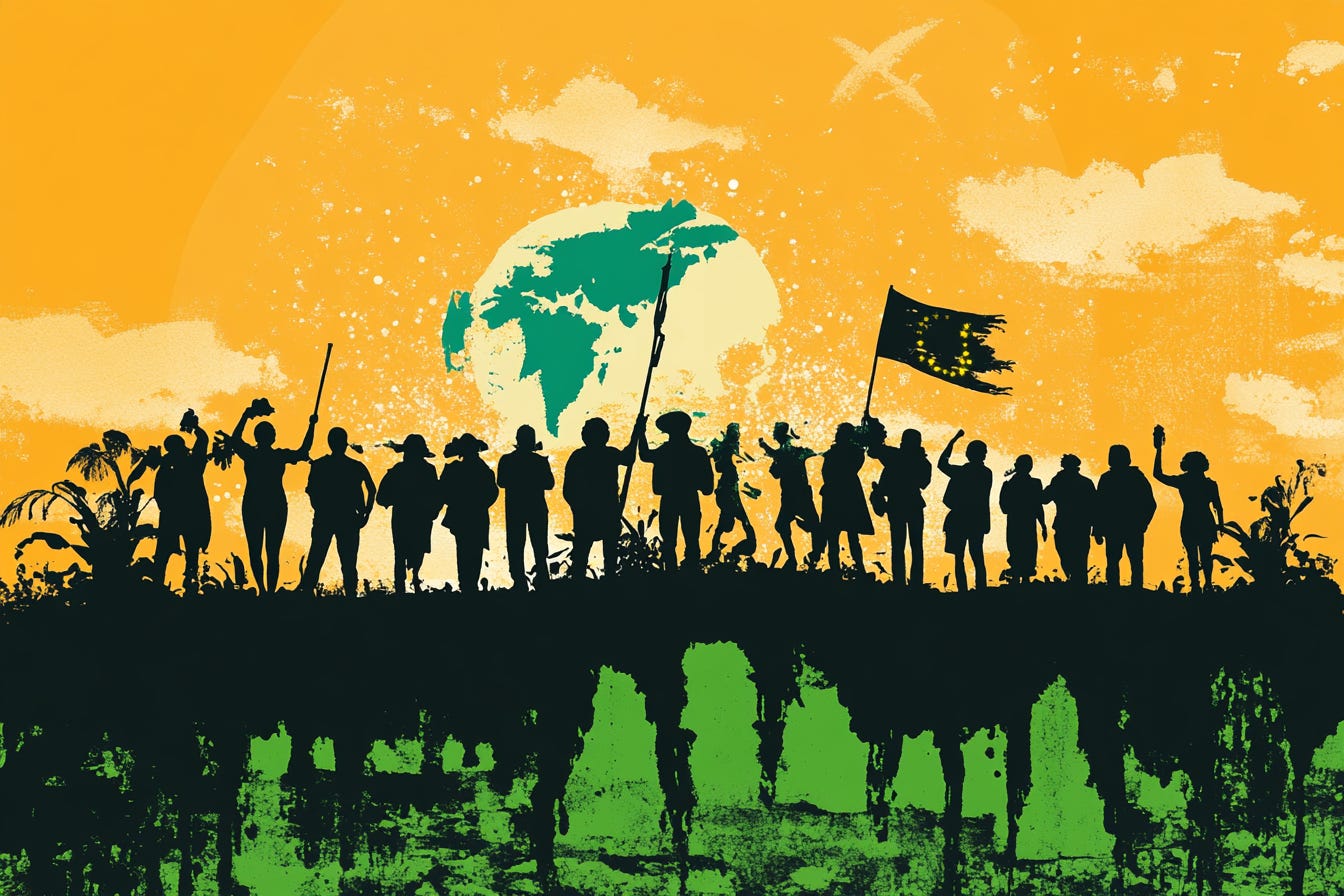
As the global climate crisis deepens and geoeconomic fragmentation worsens, trade agreements must prioritize ecological and social sustainability while promoting a different approach to globalization
On December 6th, EU Commission President Ursula von der Leyen announced a trade agreement between the EU and Mercosur countries (Argentina, Brazil, Paraguay, and Uruguay).
This ambitious deal, encompassing a market of over 750 million people, aims to eliminate tariffs on 90% of goods traded, bolstering EU industrial exports and Mercosur’s agricultural exports, particularly beef and soy.
Interestingly, opposition to this deal on the EU side has brought together two groups who are traditionally ‘foes’ from a political economy perspective: farmers and environmentalists.
Environmental Concerns
Mercosur’s agricultural dominance, especially in meat and soy production, is closely tied to deforestation. Beyond the irreversible loss of biodiversity at the regional level, deforestation drives CO2 emissions, thereby worsening the climate crisis at the global level.
Livestock farming requires extensive land, accounting for about 83% of the total agricultural land used globally. This includes both the space needed for raising cattle and the land needed to grow animal feed. While efforts to curb Amazon deforestation have made undeniable (yet insufficient) progress, other ecosystems located in Mercosur countries, like the Cerrado savannah and Gran Chaco region, face increasing deforestation rates.
These areas, critical for carbon sequestration and climate stability, are being sacrificed to agricultural expansion.
Cattle farming also generates significant greenhouse gas (GHG) emissions, with methane (a GHG with a much worse warming potential than CO2 for each ton emitted) from rumen fermentation being a major contributor.
Livestock accounts for about 10% of global anthropogenic GHG emissions, intensifying climate concerns.
Critics argue that the trade deal incentivizes livestock farming, undermining the EU’s Green Deal and climate commitments. Though the agreement includes provisions tied to the Paris Agreement, many fear their enforcement remains vague and insufficient to counter deforestation trends fueled by EU market access.
Economic Challenges for EU Farmers
Mercosur countries benefit from lower production costs due to weaker environmental and labor standards, threatening EU farmers with cheaper imports. Mercosur nations dominate global soy, maize, and poultry production, raising fears of suppressed EU prices and diminished profitability for domestic producers.
While the deal includes quotas to limit imports, such as 99,000 tonnes of Mercosur beef—representing only 1.6% of EU beef production—farmers argue that even minor competition can have significant impacts. Declining EU meat consumption exacerbates this challenge, as quotas gradually take up a larger market share.
Additionally, tariffs on beef would drop from 20% to 7.5%. French President Emmanuel Macron has criticized the deal, citing unfair competition and insufficient parity in environmental and labor standards. Similar concerns are echoed by Irish and Polish farmers.
EU farmers also highlight potential risks to food security and quality standards. For instance, a recent EU audit found that Brazil cannot guarantee exports free from growth hormones banned in the EU. Such discrepancies fuel skepticism about the trade agreement’s alignment with European health and environmental norms.
Meanwhile, Mercosur countries face risks of over-reliance on volatile agricultural exports, potentially exacerbating financial instability. The deal could deepen existing challenges, such as capital outflows during commodity price downturns, while hindering industrial diversification.
Critics warn this agreement may lock Mercosur economies into unsustainable growth models reliant on environmental degradation.
An Unlikely Alliance
The shared opposition of environmentalists and farmers reflects concerns about economic liberalization at the expense of ecological and social equity. Environmentalists argue that the deal prioritizes corporate profits over ecological integrity, jeopardizing global climate goals.
Farmers, on the other hand, emphasize the need for fair competition and support for local agriculture. While their motivations differ, both groups advocate for reevaluating the agreement to align with broader EU commitments to sustainability and equity.
To overcome these tensions between trade liberalization and sustainable development, the EU could reform its Common Agricultural Policy (CAP) to promote ecological farming and align trade policies with environmental values.
Such reforms might include reducing pesticide use, encouraging plant-based diets, and supporting farmers’ transitions to sustainable practices. By addressing farmers’ concerns, the EU could build a more resilient agricultural sector while maintaining its environmental commitments.
This approach could be accompanied by more strategic and equitable trade deals with countries like those in the Mercosur, for instance, by focusing on joint partnerships to access the critical minerals present in these countries (e.g. copper and lithium) while co-developing products such as electric vehicles.
As the global climate crisis deepens and geoeconomic fragmentation worsens, trade agreements must prioritize ecological and social sustainability while promoting a different approach to globalization.
The EU could live up to its values by paving the way toward such a radically different approach to trade agreements.
*This is a commentary version of a longer piece by the same title, published in the ECO Magazine (rivistaeco.com). For precise statistics and citations, please refer to that article

The IEP@BU Mission
Founded by Bocconi University and Institute Javotte Bocconi, the Institute for European Policymaking @ Bocconi University combines the analytic rigor of a research institute, the policy impact of a think tank, and the facts-based effort of raising public opinion’s awareness about Europe through outreach activities. The Institute, fully interdisciplinary, intends to address the multi-fold obstacles that usually stand between the design of appropriate policies and their adoption, with particular attention to consensus building and effective enforcement.
The Institute’s mission is to conduct, debate, and disseminate high-quality research on the major policy issues facing Europe, and the EU in particular, its Member States and its citizens, in a rapidly changing world.
It is independent of any business or political influence.
The IEP@BU Management Council
Catherine De Vries, IEP@BU President
Daniel Gros, IEP@BU Director
Sylvie Goulard, IEP@BU vice-President, Professor of Practice in Global affairs at SDA Bocconi School of Management
Silvia Colombo, IEP@BU Deputy Director
Carlo Altomonte, Associate Professor at Bocconi University and Associate Dean for Stakeholder Engagement Programs at SDA Bocconi School of Management
Valentina Bosetti, professor of Environmental and Climate Change Economics at Bocconi University
Elena Carletti, Dean for Research and Professor of Finance at Bocconi University
Eleanor Spaventa, Professor of European Union Law at Bocconi Law School
 | A guest post by
|
 | A guest post by
|
 | A guest post by
|