

De-globalization or slow-balization?
While the aggregate evidence suggests a trend of slow-balization, some signs of de-globalization are visible particularly in China

Taking stock of the evidence, there seems to be a slowdown of globalization, as the aggregate indexes of trade, investment, and migration consistently point to a sort of stabilization in the process of economic integration in recent years. Yet, there is no real evidence of de-globalization, which would require negative growth rates in these indicators
A main measure of globalization is the global trade-to-GDP ratio. That is, the sum of world exports and imports of goods and services measured as a share of gross domestic product. Figure 1 displays the evolution of this indicator between 1970 and 2023 based on World Bank data.
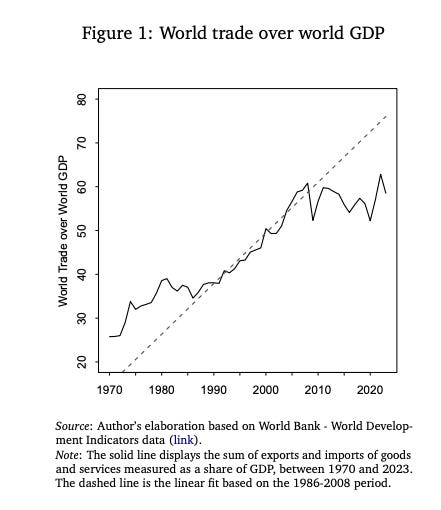
As in Antràs (2021), the dashed line represents the linear forecast based on the time-interval 1986-2008, which was a period of fast-paced growth of globalization. After the peak of 2008, the global economy clearly deviates from this trajectory of hyperglobalization.
Net of some year-on-year fluctuations, the world trade-to-GDP ratio seems to stabilize around a slightly lower level. Moving to foreign direct investment flows, Figure 2 shows the evolution of world FDI net inflows over world GDP, between 1980 and 2023.
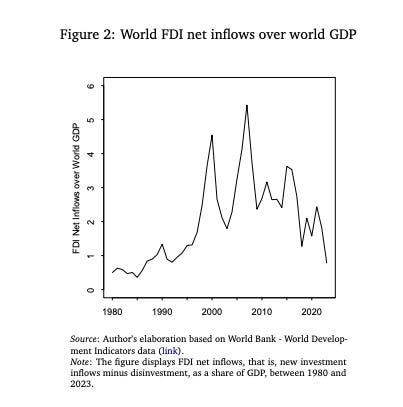
FDI net inflows are obtained as the difference between new investment inflows minus disinvestment. Similar to the evolution of the trade-to-GDP ratio, net of yearly fluctuations, this index drops substantially after the peak around the Great Financial Crisis.
Finally, considering the cross-border flows of people, Figure 3 displays the share of international migrants over the world population (left panel), and its growth rate over time (right panel), between 1990 and 2019. Data are sourced from the Global Migration Database of the United Nations.
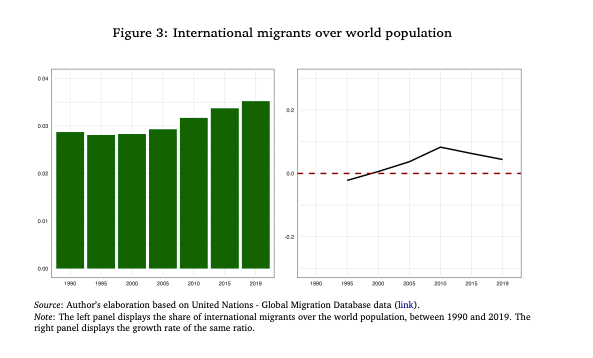
The pattern is less stark in this case. In fact, the share of migrants keeps growing from 1995 onwards, yet the growth rate slows down after 2010.
Taking stock of the evidence, there seems to be a slowdown of globalization, as the aggregate indexes of trade, investment, and migration consistently point to a sort of stabilization in the process of economic integration in recent years.
Yet, there is no real evidence of de-globalization, which would require negative growth rates in these indicators. The observed dynamics thus far point more to a process of slow-balization, rather than de-globalization.
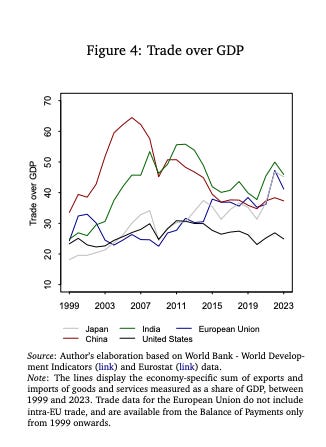
This was already noticed by Antràs (2021) and Goldberg and Reed (2023), and continues to hold true when the analysis is updated to include the most recent available years of data. Next, I explore heterogeneity in trade and FDI flows across five major economies: China, the European Union, Japan, India, and the United States.
Specifically, Figure 4 considers the trade-to-GDP ratio, while Figure 5 displays the net FDI inflows over GDP for each economy. Overall, there seems to be a significant degree of heterogeneity. In particular, the trade-to-GDP ratio decreases significantly in China and India, experiences a slight decline in the US, and continues to grow in both the EU and Japan.
The ratio of net FDI inflows to GDP declines more sharply in China and the EU, decreases more moderately in India, remains essentially stable in the US, and shows a slight increase in Japan.
In sum, while the aggregate evidence suggests a trend of slow-balization, some signs of de-globalization are visible, particularly in China, which had been a key driver and major beneficiary of the rapid globalization wave until the Great Financial Crisis.
This article is an excerpt from Italo Colantone’s most recent paper, De-Globalization and Fragmentation which you can read here
Download the Working Paper

Italo Colantone

Italo Colantone is an Associate Professor of Economic Policy at Bocconi University, in Milan. He works in the Department of Social and Political Sciences. He is a Research Fellow of the BAFFI CAREFIN Research Centre and of CESifo. He is a Senior Researcher of FEEM.
He teaches "Economics and Politics of the European Union", "European Economic Policy", "Macroeconomics", "Economics of European Integration", and "European Policy". His research focuses on International Trade, Political Economics, and Applied Industrial Organization.

The IEP@BU Mission
Founded by Bocconi University and Institute Javotte Bocconi, the Institute for European Policymaking @ Bocconi University combines the analytic rigor of a research institute, the policy impact of a think tank, and the facts-based effort of raising public opinion’s awareness about Europe through outreach activities. The Institute, fully interdisciplinary, intends to address the multi-fold obstacles that usually stand between the design of appropriate policies and their adoption, with particular attention to consensus building and effective enforcement.
The Institute’s mission is to conduct, debate, and disseminate high-quality research on the major policy issues facing Europe, and the EU in particular, its Member States and its citizens, in a rapidly changing world.
It is independent of any business or political influence.
The IEP@BU Management Council
Catherine De Vries, IEP@BU President
Daniel Gros, IEP@BU Director
Sylvie Goulard, IEP@BU vice-President, Professor of Practice in Global affairs at SDA Bocconi School of Management
Silvia Colombo, IEP@BU Deputy Director
Carlo Altomonte, Associate Professor at Bocconi University and Associate Dean for Stakeholder Engagement Programs at SDA Bocconi School of Management
Valentina Bosetti, professor of Environmental and Climate Change Economics at Bocconi University
Elena Carletti, Dean for Research and Professor of Finance at Bocconi University
Eleanor Spaventa, Professor of European Union Law at Bocconi Law School
Sorry, I am not an expert. What do you exactly mean for balization? Fragmentation? Erosion?